

How To Fix A Drafty House
We're sorry, there seems to be an issue playing this video. Please refresh the page or try once again in a moment. If you continue to have problems, delight contact us here.
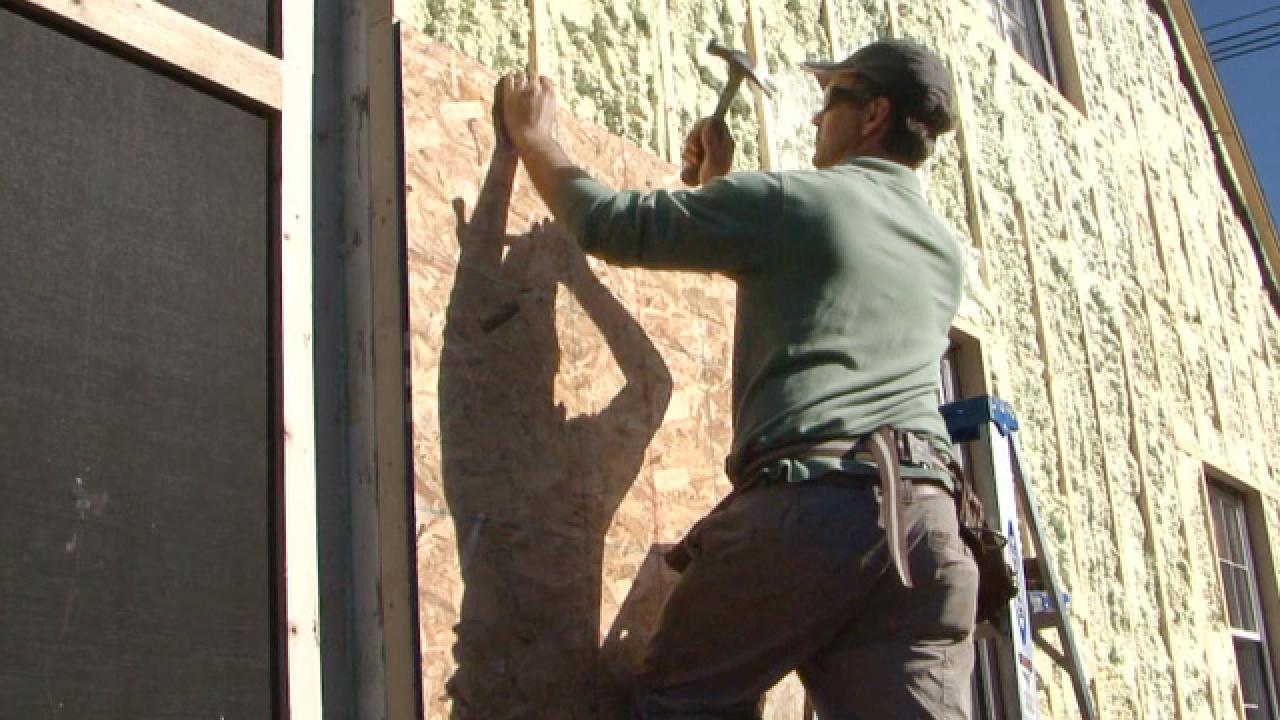
A leaky business firm tin can run upwardly hefty free energy bills. And then rather than standing to heat and cool a lxx-year-old habitation with virtually no insulation, the Wilson family embarked on a Deep Free energy Retrofit (DER) that will eventually bring the operating cost of their business firm downwards to zero.
Imagine not paying to heat or cool your home.
"I'm hoping we tin salve 50 to 90 percent on our energy costs from the process, which is a combination of air sealing, insulation, windows and doors and new off-the-shelf HVAC technology," says Jeff Wilson, who bound-started the DER on his Athens, Ohio, home with a thorough free energy audit and assessment to pinpoint leaks.
Air sealing is a key component of the DER and what will allow the Wilsons to live comfortably in their habitation.
"The idea that you have to freeze in the dark in the new energy economy is incorrect," Jeff says. "We want our houses to be more responsive, healthier and cheaper to run. We can have that."
Before Air Sealing the Dwelling house
Five years ago Jeff began exploring means to meliorate the insulation in his domicile. Similar most sometime houses, the construction left a gap — a big air pocket — between the plaster wall and the original redwood exterior siding. (The previous owners had slapped aluminum siding on top of this damaged surface.)
Jeff hired a company to accident cellulose insulation into the walls to fill that gap. Cellulose is substantially chopped-up newspaper treated with a burn retardant. Pieces of outside siding are removed, and holes are punched into the surface to make room for hoses that force insulation into the wall. The damp cellulose expands in the wall cavity and prevents air passage. The price of this service was $1,200 in 2005.
Immediately subsequently, Wilsons' heating bills dropped ten percent to 15 percent. "And in that location was less racket from outside," he adds. Because the forepart of the home is brick, cellulose was diddled in through interior walls. Jeff patched up holes in the plaster wall after the projection.
Nonetheless, subsequently this boosted padding, the average monthly cost of heating and cooling the home was $160. Jeff intended to slash this cost, tighten the home and improve indoor air quality with air sealing.
Air Sealing Two Ways
Jeff used a combination of greenish retrofit technology and new construction techniques on his home air sealing project. The original home needed a "curtain wall" — layers of insulation enveloping the home. The new garage/addition was insulated from the interior, using the same products just a different awarding technique.
House: Air sealing efforts focused on insulating the exterior of the home. This required removal of the aluminum siding, which revealed rotted redwood siding. Underneath the siding was plank sheathing stock-still to the abode'southward skeleton — 2x4 framing. Cellulose filled the cavity between the framing and the plaster interior walls.
Jeff used the redwood siding as his starting point, fixing 2x3 studs (the skeleton) into the redwood siding that looked similar a filigree. And so, Jeff filled those gaps with two 1/2 inches of Foam-Information technology Light-green spray-foam insulation. Over the foam, Jeff fixed standard sheathing. On pinnacle of this, he applied house wrap. "The business firm wrap was a picayune redundant because the air sealing from the foam would take air sealed the business firm, just we were concerned nearly making this last," Jeff says.
Siding was the terminal step, and Jeff opted for SmartSide, which is ready-to-paint engineered wood siding treated with nontoxic resins.
New Garage/Addition: Jeff employed new structure techniques on the garage/addition, building 2x6 walls for a deeper cavity to agree more than insulation. (Past comparison, the original home's walls are a true 2x4.) Sheathing was applied on top of the new addition'south framing, followed by house wrap. Then, Jeff worked on insulating the interior wall since he had consummate access to this surface — different with the original dwelling house, which already had painted plaster walls in identify.
Jeff filled between the framing with 2 1/2 inches of Foam-It Green spray insulation. That gave him three more inches of wall cavity to add more insulation, and then he chose fiberglass batting with an free energy efficient rating, or R-value, of R-13. Finally, interior walls were installed. (Call back, the original abode's cavity is filled with less-efficient cellulose and air sealing was accomplished by insulating the outside.)
Garage Flooring: Rather than laying a basic concrete slab floor, Jeff opted for a floating slab that is cradled with foam insulation four inches thick on the lesser and ii inches thick on the sides. "The slab doesn't touch on concrete cake or dirt," he explains. "It sits on foam, and in that location is plastic underneath to go on moisture from seeping through."
Why bother insulating the flooring? Past doing so, Jeff volition prevent oestrus loss and common cold air entry through the cement. "Even though it's a garage, it'south still a workshop and upstairs is space we'll inhabit as an office or sleeping accommodation," he says.
DIY Tips
The insulating techniques Jeff used will requite the home a long-lasting air seal — at least 70 years, and probably longer, he estimates. "We're non only making the firm final longer, we're calculation something to it that's merely non going to go away," he explains. "The payback is dependent on what energy costs do in the coming years."
- If you lot want to beefiness upward the insulation in your habitation, start by finding out where the leaky spots are by getting an energy audit. That way you can focus your dollars on trouble spots.
- Blown-in cellulose insulation can fill empty wall cavities and decrease heating bills. Jeff realized a ten percent to 15 percent savings immediately for the $1,200 project.
- When planning a new addition, investigate off-the-shelf technologies that will boost your home'due south R-value. Jeff double-insulated using spray foam and batting, achieving R-27 — double the efficiency of his abode'due south walls when they were only filled with cellulose.
Source: https://www.hgtv.com/design/remodel/mechanical-systems/air-sealing-a-drafty-house
0 Response to "How To Fix A Drafty House"
Post a Comment